Guide 01
Croissants, baguettes and the laminated morning
Butter, flour, water, salt, yeast and cold hands. Out of that short list Paris builds its loudest breakfast: a pastry that crackles when you break it and drops a small golden snowfall onto your coat.
What lamination is, and why it matters
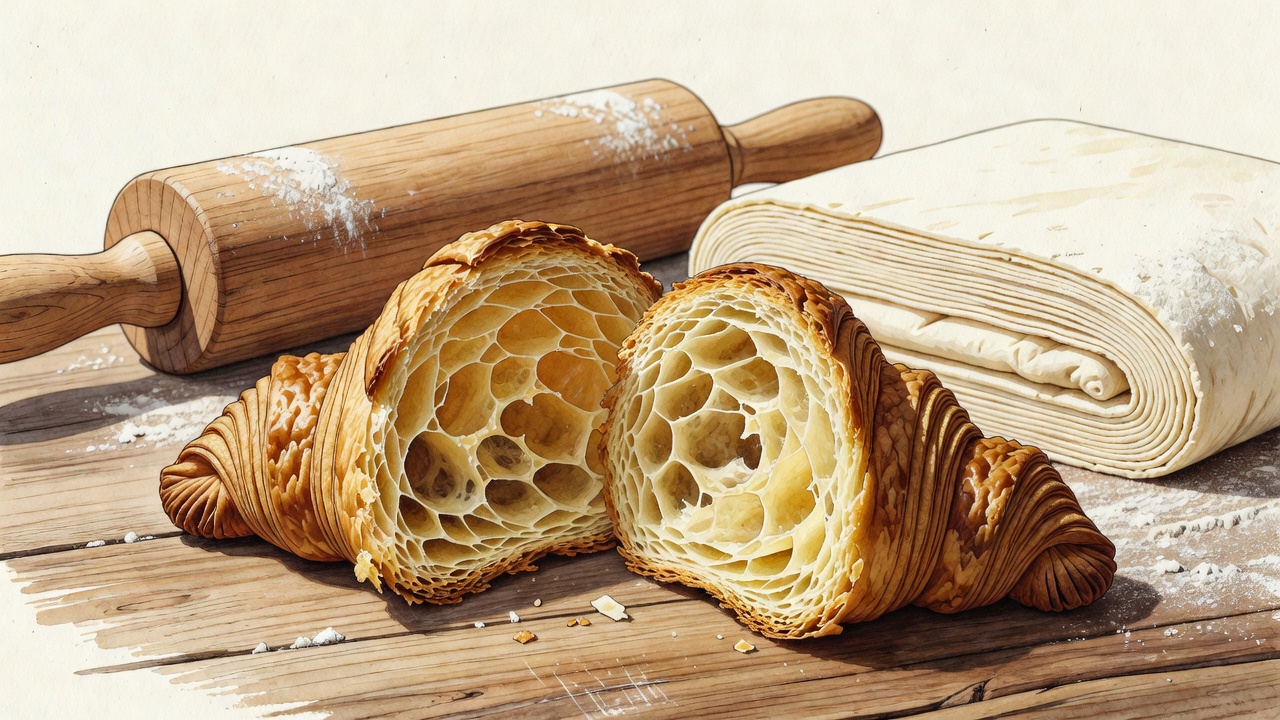
Lamination is the folding of a block of butter into a sheet of yeasted dough, then rolling and folding again until fat and dough alternate in dozens of paper-thin beds. In the oven the water in the butter turns to steam, each layer lifts the one above it, and the whole structure sets into that open, glossy honeycomb. Nothing else produces it. A croissant is not bread with butter in it; it is an architecture, and like any architecture it fails visibly when the builder is in a hurry.
That is why a croissant is such a reliable test of a bakery. Tear one in half. The interior should look like a section through a sea sponge — irregular chambers, thin shining walls, a faint spiral you can follow with your eye. The exterior should be the colour of a varnished violin and should splinter rather than squash. If the inside is tight and uniformly crumbed, the dough was warm when it was rolled and the layers merged. If the outside is pale and soft, the oven was too cool or the proving too long.
Butter is the whole argument
French bakers talk about beurre de tourage, a butter with a higher fat content and a plastic, pliable texture that can be rolled thin without cracking or melting into the dough. Many Parisian houses advertise butter carrying the AOP Charentes-Poitou protected designation of origin, which covers butter produced to a defined method in western France. It is worth noticing when a bakery names its butter on the label: it costs more than the alternative, and nobody pays more quietly.
There is also a convention about shape that visitors find useful and bakers occasionally grumble about. In French trade practice, a croissant made with pure butter is shaped straight, while one made with other fats is curved into the crescent that gave the pastry its name. It is a convention rather than a universal rule, so read the label as well as the silhouette — but in a busy quartier bakery, a tray of straight croissants labelled au beurre is a fair signal of intent.
Beyond the croissant
The word viennoiserie covers everything the laminating bench produces. The pain au chocolat — chocolatine, if you are arguing with someone from the south-west — is the same dough wrapped around two batons of chocolate, and it lives or dies on whether those batons stay distinct or bleed into a single sweet smear. The pain aux raisins, coiled around crème pâtissière, is the pastry that most punishes a mean hand: too little cream and it is dry bread with fruit in it.
Then there are the regional incomers that Paris adopted. The kouign-amann, from Douarnenez in Brittany, is laminated dough with sugar folded in so that the outside caramelises into something between toffee and glass. The chausson aux pommes hides stewed apple under a puffed lid scored with curved lines. And the brioche family sits slightly apart — enriched rather than laminated, soft as a pillow, at its best when it pulls apart in threads.
The baguette, and the law behind it
Bread is the other half of the morning. A baguette de tradition française is defined by a French decree of 1993, which limits it to flour, water, salt and yeast or leaven, with a short list of permitted additions, and forbids freezing at any stage. That is why the tradition costs more than the ordinary baguette sitting next to it, and why it stales faster: there is nothing in it to hold moisture. Ask for une tradition and you are asking for the regulated version.
The City of Paris runs an annual competition for the best baguette de tradition in the city, the Grand Prix de la Baguette de Tradition Française. The winner supplies the Élysée Palace for the following year, which means the prize turns an ordinary corner bakery into a queue overnight. Winners' plaques stay on the window for decades, so treat a plaque as a note about the past rather than a promise about this morning's bake.
Houses worth walking to
Poilâne, on rue du Cherche-Midi in the 6th, is built around one object: a large round sourdough loaf of grey-brown wheat, baked in a wood-fired oven, sold whole or by the quarter. Buy a slice, eat it with salted butter, and the punitions — small round shortbread biscuits — on the way out.
Du Pain et des Idées, on rue Yves Toudic near the Canal Saint-Martin, works in a preserved nineteenth-century shop with a painted ceiling. It is known for the pain des amis, a flat, fiercely crusted loaf, and for escargots, snail-coiled pastries sold in flavour combinations that change through the week.
Stohrer, on rue Montorgueil in the 2nd, is the city's long-running pâtisserie, founded in 1730 by Nicolas Stohrer, who had worked for the exiled Polish king Stanisław Leszczyński and followed his daughter to Versailles. It is a pastry shop first, but its viennoiserie and its painted interior are both reasons to go.
Finally, do not overlook the ordinary corner boulangerie with three trays and a queue of neighbours. Paris keeps its standard high at the bottom of the market as well as the top, and the best croissant of your trip may well come from a shop with no name you recognise. Next, see how that morning dough turns into the afternoon pâtisserie repertoire, or find the streets that concentrate it in the neighbourhood guide.