Guide 05
Ordering, timing and the words that matter
Half of eating well in Paris is knowing eleven words and one greeting. The counter moves fast, the queue behind you is patient but not infinitely so, and the right phrase lands your coffee in front of you before your coat is off.
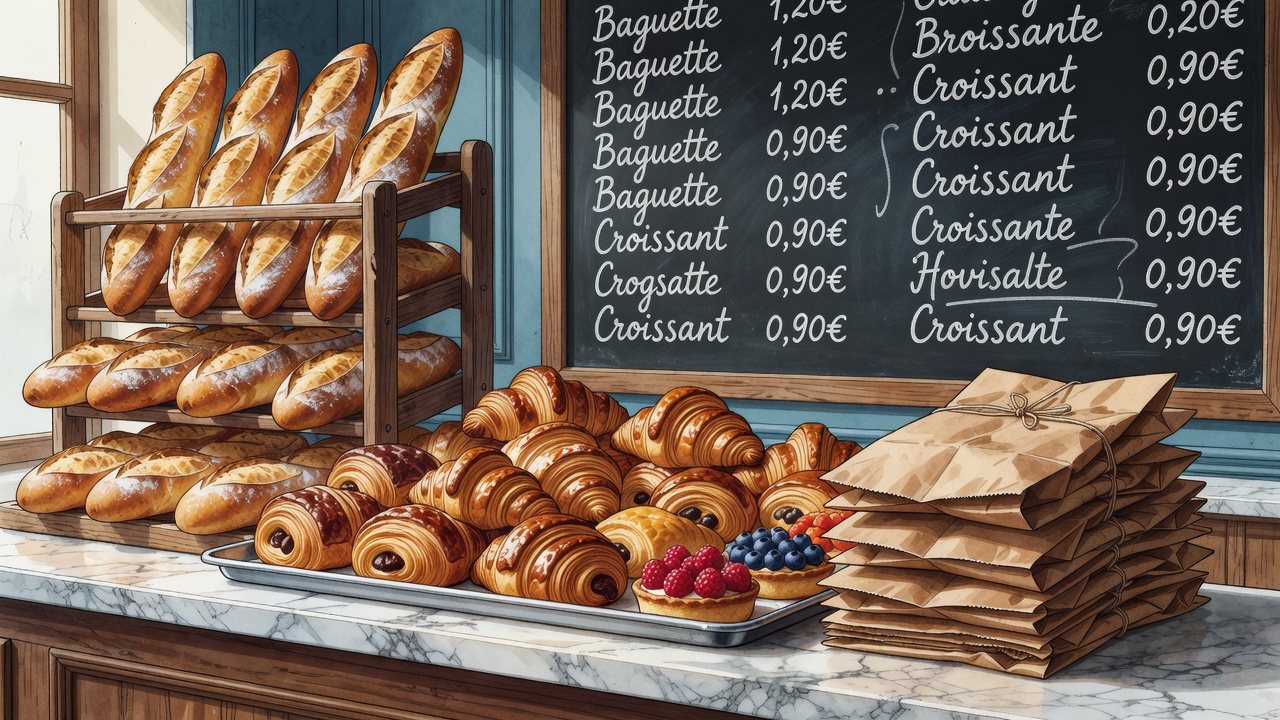
Start with bonjour
This is not a nicety, it is the door handle. In a French shop or café, you greet the room before you ask for anything: bonjour to the person behind the counter, bonsoir after dark, au revoir or bonne journée on the way out. Ordering without greeting reads as brusque in a way that has nothing to do with your accent. The rest of the transaction can be done in three words and a pointed finger, and nobody will mind at all.
The coffee vocabulary
| What you say | What you get |
|---|---|
| Un café | A small, strong espresso — the traditional default cup. |
| Une noisette | An espresso with a small amount of milk, turning it hazelnut-coloured. |
| Un café allongé | The same shot pulled with more water, so a longer, lighter cup. |
| Un café crème | Espresso with steamed milk, the usual morning drink. A petit crème is the smaller size. |
| Un déca | Decaffeinated, which can be combined with any of the above. |
| Un chocolat chaud | Hot chocolate; in the tearoom tradition it is thick rather than milky. |
| Une carafe d'eau | Tap water, served free with an order in French cafés and restaurants. |
Sur place or à emporter
When you buy food or drink in France you will be asked whether it is sur place — eaten here — or à emporter, taken away. Answer honestly, because it is not small talk: catering consumed on the premises and food sold to take away fall under different reduced rates of VAT, so the two are billed differently and the till needs to know which it is. The current rates are published by the French tax administration at impots.gouv.fr if you want the exact figures.
In cafés, the same principle extends to where you sit. Counter, room and terrace are commonly priced differently, and the tariff must be displayed. Check the board before you choose a seat, not after.
What the words on the shopfront guarantee
Two pieces of French law are genuinely useful to a visitor.
The first is the 1998 law governing the words boulanger and boulangerie. A business may only use them if the bread it sells is kneaded, shaped and baked on the premises, and is not frozen at any point in the process. A shop selling bread baked elsewhere has to call itself something else — dépôt de pain, or simply a shop that sells bread. When you see boulangerie painted on the glass, it is a legal statement about where the oven is.
The second is the 1993 decree on pain de tradition française. It restricts the loaf to flour, water, salt and leavening, with a short list of permitted additions and no freezing. Ordering une tradition rather than une baguette gets you that regulated bread; it costs a little more and goes stale faster, which is the honest consequence of a short ingredient list. Both texts are published on Légifrance if you want the source.
Tipping, paying, and the bill
Service is included in French cafés and restaurants — service compris — and the displayed price is the price you pay. Rounding up or leaving small change for good service is common and appreciated; a percentage calculation is not expected. Card payment is usual, but a small bakery may have a minimum for card transactions, so a few coins in a pocket saves a conversation.
Timing your day
- Early morning is when viennoiserie is at its peak. Laminated pastry loses its crackle within hours; by late afternoon you are eating a different, sadder object.
- Late morning is the best window for pâtisserie, when the day's cream-filled pieces have been set out but have not been standing.
- Between services, roughly mid-afternoon, many bistrots close their kitchens while cafés and salons de thé stay open. Plan the cake, not the lunch, for that gap.
- Closing days vary by shop. Many bakeries take one fixed day off a week, and it is not always Sunday, so check before crossing the city for a specific address.
- August is the traditional holiday month, and independent shops often close for two or three weeks. A handwritten note in the window is the usual announcement.
Small courtesies that make the queue work
Decide what you want before you reach the front; the window is there to be read from the back of the line. Say the number first, then the item: deux croissants, s'il vous plaît. Don't touch the pastries — the tongs belong to the staff. If you want the bread for later, ask for it pas trop cuite or bien cuite to get it paler or darker, which is a genuine preference rather than a fussy one. And carry your own bag if you can; a baguette travels perfectly well under an arm, as it has for a very long time.
With the words in place, the rest of the guides are simply directions: start with the morning dough, move to the afternoon window, and pick a street from the neighbourhood guide.