Guide 04
Neighbourhood by neighbourhood
Paris is walkable in the way a staircase is climbable: you do it in flights. Each of these quarters holds enough bread, cream and coffee for one morning, and the walk between them is half the pleasure.
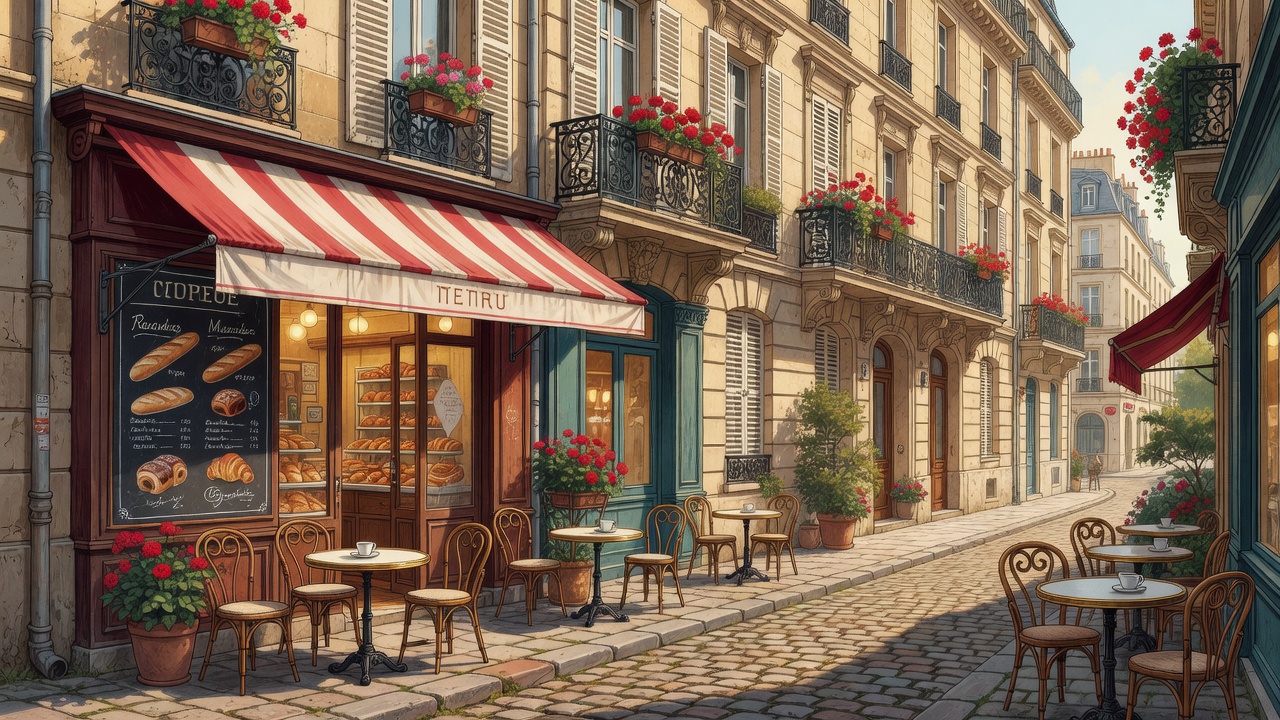
2nd: rue Montorgueil and the market spine
Rue Montorgueil is a surviving market street, pedestrianised along most of its length, sloping gently and lined with fishmongers, cheese counters and awnings. Stohrer, founded here in 1730, is the anchor — the baba au rhum is its historic dish and the painted interior is worth the visit on its own. Around it the street works as a single food organism: buy bread at one end, cheese in the middle, a coffee standing at any of the cafés along the way. It is busy, and busiest at weekends, which is its character rather than its flaw.
6th: Saint-Germain-des-Prés
The Left Bank's grandest pastry walk. Poilâne on rue du Cherche-Midi sells its wood-fired sourdough miche by the quarter and its punitions by the bagful. A few minutes away, boulevard Saint-Germain holds Café de Flore and Les Deux Magots, the two literary cafés that have defined the quarter's image for the better part of a century. Expect landmark prices at the famous terraces and quieter value on the side streets behind them. Pierre Hermé has long had a presence in this arrondissement, and the streets between Odéon and Saint-Sulpice reward aimless walking more than a fixed itinerary.
9th: rue des Martyrs
A steep, narrow, resolutely local shopping street running north towards Montmartre, and one of the most concentrated food streets in the city. Bakeries, pâtisseries, cheesemongers and greengrocers sit shoulder to shoulder, and the customers are mostly people who live within five minutes' walk. Go in the morning, go up rather than down, and finish at the top with a coffee before continuing into the 18th.
10th: the Canal Saint-Martin and rue Yves Toudic
The canal quarter is where much of the city's modern café scene took hold. Du Pain et des Idées on rue Yves Toudic is the landmark bakery, with its pain des amis and its coiled escargots, and Ten Belles nearby is among the addresses most associated with the arrival of specialty coffee in Paris. The iron footbridges, the plane trees and the long line of people sitting on the quayside give the area a looser, less formal texture than the Right Bank centre.
3rd and 4th: the Marais
Dense, medieval-grained streets, a high concentration of small shops, and — importantly for visitors — a quarter where many places open on Sundays, when much of Paris shutters. Jacques Genin, on rue de Turenne, is the address most associated with chocolate and with a mille-feuille assembled to order, which is an unusual and worthwhile thing to encounter. The Marais also has the highest density of tourist traffic outside the 1st, so streets one block off the main axes are almost always better value.
1st: Rivoli and the Palais-Royal
This is the quarter of grand tearooms rather than corner bakeries. Angelina, on rue de Rivoli, is known for a very thick hot chocolate and for the Mont-Blanc, a dome of chestnut vermicelli over meringue and cream. It is an experience priced as one. Nearby, the arcades of the Palais-Royal offer the quietest benches in central Paris for eating something out of a paper bag, which is an underrated municipal service.
11th, 18th and 20th: Oberkampf, Montmartre, Belleville
East and north is where the city's newer baking energy concentrates. Around Oberkampf in the 11th, modern bakeries have built reputations on pastry that departs from the classical window while keeping the technique. Montmartre in the 18th splits sharply between the tourist plateau around the Sacré-Cœur and the genuinely residential streets below it — walk downhill and the prices drop with the gradient. Belleville in the 20th is the home of Belleville Brûlerie and a good example of a quarter where roasting, not just serving, happens.
Building a morning out of this
The useful pattern is simple. Pick one quarter. Start with something laminated as early as you can manage, because viennoiserie is at its best within a couple of hours of the oven. Walk. Take a coffee standing at a counter around mid-morning, when the room is busy and the machine is hot. Finish with one cream pastry, eaten the same day. Then stop — the temptation to buy six things and photograph all of them is exactly how a good morning turns into a heavy afternoon.
For the vocabulary you will need at each counter, read the ordering guide; for what to look for in the window, start with viennoiserie.