Guide 03
Café culture, from zinc counter to filter cone
A Parisian café is a public room with a licence. It sells coffee the way a bus sells seats — briskly, to everyone, all day. Understanding how that room is organised is worth more than any list of addresses.
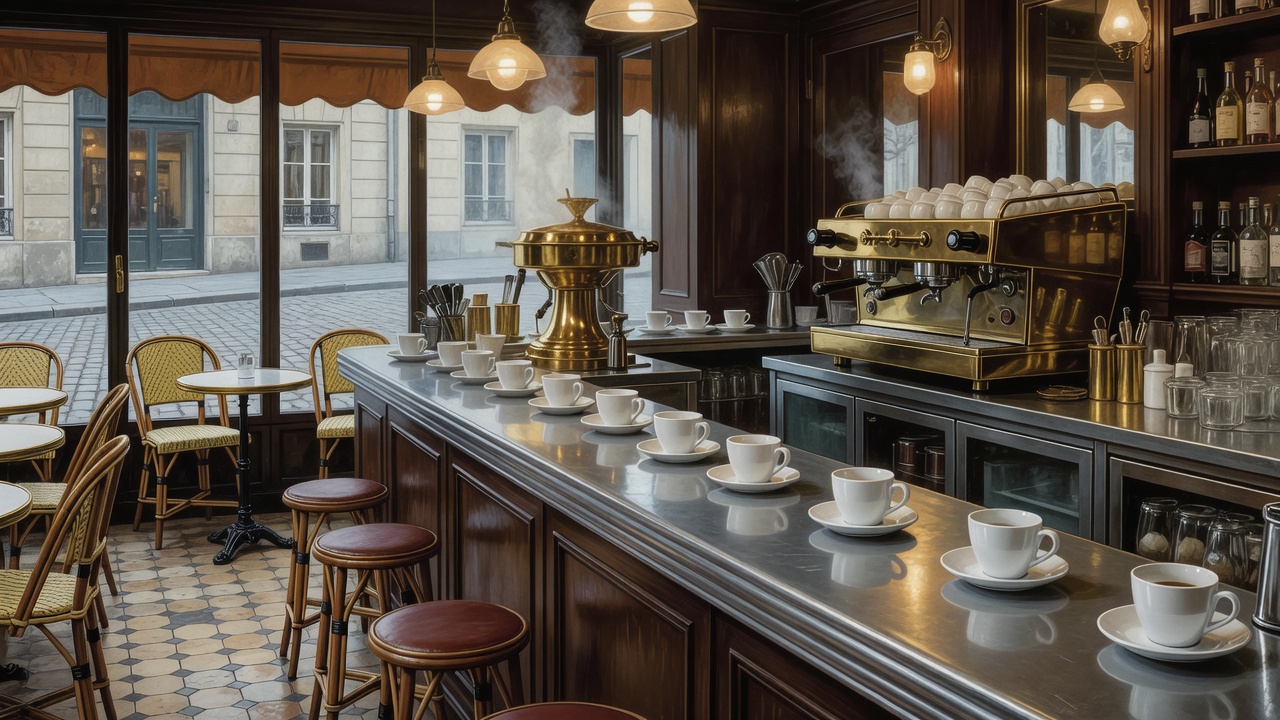
Three prices, one coffee
The first thing to understand is the tariff. Many Parisian cafés charge differently depending on where you consume: standing at the counter, seated in the room, or seated on the terrace. Prices must be displayed, so the board behind the bar or the card by the door will tell you exactly what each service position costs before you commit. Nothing about this is a trick played on outsiders — locals use the counter precisely because it is the cheap, fast option.
The counter, the comptoir, is usually a long slab of zinc or brass with a brass rail at ankle height. It is where the neighbourhood passes through: a coffee drunk in ninety seconds, a word with the barman, out. The terrace is the opposite proposition. You are renting a view of the street and a chair angled towards it, and nobody will move you along. Both are legitimate; they are simply different products.
Café, bistrot, brasserie, salon de thé
These words are used loosely, but they do mean different things. A café serves drinks all day with a short food offer. A bistrot is a small restaurant with a limited, usually handwritten menu, serving at fixed mealtimes. A brasserie — originally a brewery — is larger, serves continuously, and leans on shellfish, choucroute and steak. A salon de thé is built around pastry and tea rather than alcohol, and generally keeps shorter hours. If you want coffee at three in the afternoon with a cake, the salon de thé and the café are your options; the bistrot may be closed between services.
What a cup of coffee actually is here
Order un café in a traditional café and you receive a small, dark espresso — the petit noir. The classic French roast profile runs darker than the Nordic-influenced style now common in specialty bars, and the traditional blend often includes robusta, which is part of why it tastes bitter, heavy and slightly rubbery to palates raised on lighter roasts. That is a style, not a fault, though it is a style many Parisians themselves have been moving away from.
The rest of the vocabulary follows from that small black cup. A noisette is an espresso with a hazelnut-coloured drop of milk. A café allongé is the same shot pulled long with more water. A café crème is the breakfast drink, espresso with steamed milk, and a déca is decaffeinated. The full vocabulary, including how to ask for it, is in the ordering guide.
The houses that became landmarks
Le Procope, on rue de l'Ancienne-Comédie in the 6th, dates from 1686 and is generally described as the oldest café in Paris; it operates today as a restaurant, and its interest is historical as much as culinary. A short walk away on boulevard Saint-Germain, Café de Flore and Les Deux Magots sit almost side by side, both indelibly associated with the mid-twentieth-century literary and philosophical life of Saint-Germain-des-Prés. Les Deux Magots takes its name and its two carved figures from the draper's shop that previously occupied the site.
Montparnasse holds the other cluster: Le Select, La Rotonde, Le Dôme and La Coupole, the cafés of the interwar artistic migration, with La Closerie des Lilas a little further along the boulevard. These are landmark rooms, priced accordingly, and best approached as what they are — historic interiors where you pay for the chair and the ceiling. Order one thing, sit for an hour, and consider it a museum ticket with a drink attached.
The specialty wave
From the late 2000s a second coffee culture grew up alongside the first: small roasteries and bars working with lighter roasts, single-origin beans, espresso weighed to the gram and filter brewed to order. Belleville Brûlerie, up in the 20th, Coutume on the Left Bank and Ten Belles near the Canal Saint-Martin are among the names most closely associated with that shift, and many of them roast as well as serve.
The trade-offs are real and worth stating plainly. Specialty bars give you better coffee, more information about it and usually a better pastry; they give you smaller rooms, shorter hours, a queue, and none of the all-day civic function of the corner café. A traditional café gives you a table at nine at night, a bathroom, a place to shelter from rain and a barman who will let you sit over one cup — but the coffee is a commodity. Most people in Paris use both, for different purposes, on the same day.
Where to find both within a few streets of each other is the subject of the neighbourhood guide.