Guide 02
The classic pâtisserie repertoire
A Parisian pastry window is a cabinet of small engineering: choux rings glazed like lacquer, cream piped into ridges sharp enough to cast a shadow, caramel set hard as amber. Here is the canon, and how to tell a good one from a merely photogenic one.
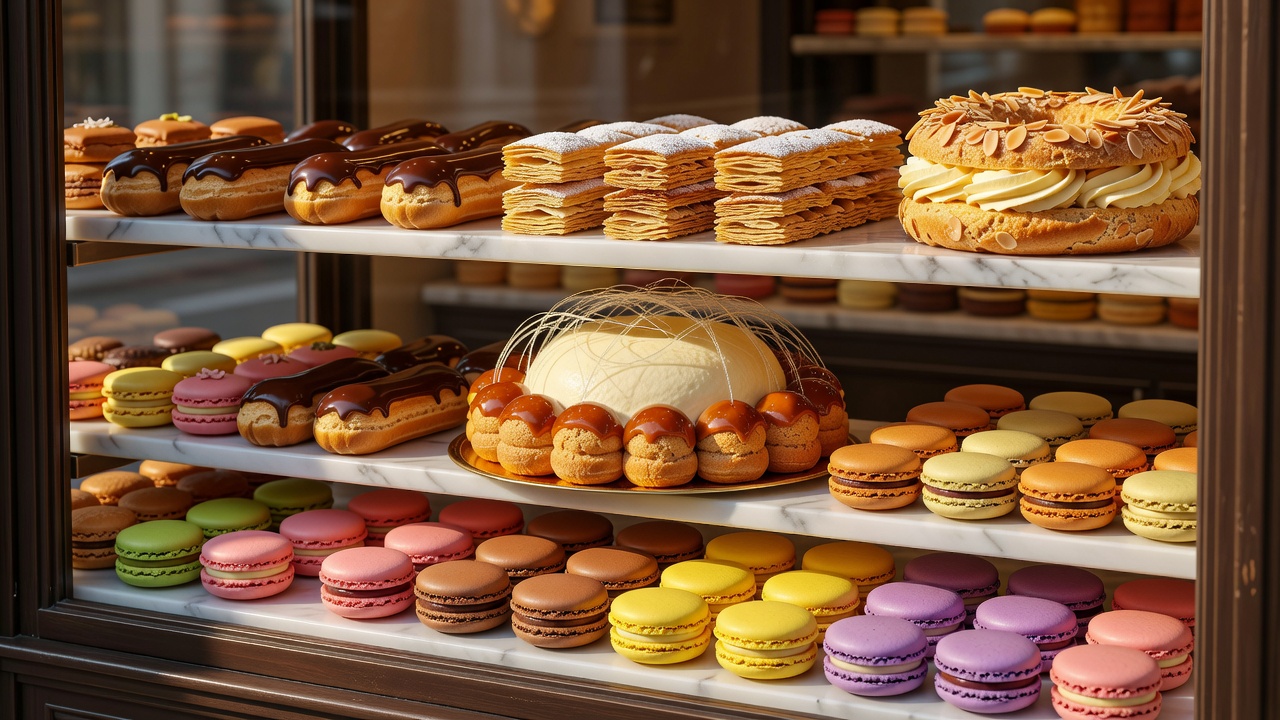
Choux: the family that runs the window
Choux paste is cooked twice — once in the pan, once in the oven — and it puffs into a hollow shell that exists to be filled. Almost every icon in a Parisian window belongs to this family.
The éclair is the plainest and the least forgiving: a straight tube of choux, a fill of crème pâtissière, a fondant lid. Chocolate and coffee are the traditional pair. The test is the pastry itself, which should be dry and crisp enough to give slight resistance before it yields, and the fondant, which should be thin and set rather than thick and chalky.
The religieuse stacks a small choux bun on a large one and pipes a collar of buttercream around the join, a shape said to recall a nun's habit. The Paris-Brest is a ring of choux split and filled with praline cream, created by the pâtissier Louis Durand in Maisons-Laffitte in the early twentieth century in honour of the Paris–Brest–Paris cycling event, its silhouette borrowed from a bicycle wheel. Judge it on the praline: it should taste of toasted hazelnut rather than generic sweetness, and the cream should be light enough to eat a whole one.
The Saint-Honoré sits on a puff-pastry base, ringed with caramel-dipped choux buns and piped with crème Chiboust, the cream named for the pâtissier whose shop stood on rue Saint-Honoré. It is the most structurally ambitious of the group and the one most likely to defeat a plastic fork. Caramel that has gone sticky or weeping means it has been standing too long.
Layers, cream and restraint
The mille-feuille is three sheets of puff pastry with crème pâtissière between them, topped either with feathered fondant or, in the modern style, simply dusted and left bare. Everything depends on caramelisation: the pastry should be baked deep, compressed and glassy, so that a fork press produces a clean crack rather than a slow squash. Vanilla is the classic, and a good one smells of it before you lift it.
The tarte au citron is a test of balance rather than technique. The curd should sting slightly at the edges of the tongue, the pastry should stay sandy under it, and meringue, if present, should be scorched rather than sweetened into submission. The tarte Tatin, upside-down caramelised apple in pastry, comes from the Loiret town of Lamotte-Beuvron and is better in a bistrot, warm, than in a box.
The opéra is the great flat cake of the repertoire: joconde sponge soaked in coffee syrup, coffee buttercream, chocolate ganache, mirror glaze, repeated in thin ruled strata. Its creation is credited to Dalloyau in the mid-twentieth century. Cut a slice and look at the side — the layers should be even enough to have been drawn with a ruler, and the coffee should be bitter enough to hold the butter in check.
Baba, and a thread back to Versailles
The baba au rhum is a yeasted, airy cake soaked in rum syrup, often served with a jug of extra rum and a quenelle of lightly whipped cream. Its Parisian home is Stohrer on rue Montorgueil, founded in 1730 by Nicolas Stohrer, pastry chef to the exiled Polish king Stanisław Leszczyński and later at Versailles in the household of his daughter, Queen Marie Leszczyńska. That is an unusually direct line from an eighteenth-century court to a shop you can walk into with a five-euro note.
Macarons and the modern houses
The Parisian macaron — two smooth-domed almond shells with a ganache or buttercream between them — is the pastry most responsible for the city's pastry tourism. Ladurée is the house most often credited with popularising the sandwiched form, and its rue Royale premises remain the origin address. Pierre Hermé built a different reputation on flavour combination rather than pastel presentation; his Ispahan, pairing rose, lychee and raspberry, is the most widely recognised of his creations and appears across his range in different formats.
The contemporary end of the craft has moved towards sculpture. Cédric Grolet, at Le Meurice, is known for trompe-l'œil fruit: pastries painted and shaped to look exactly like a lemon, a walnut or an apple, which break open to reveal compote and ganache inside. Whether that is pastry or theatre is a fair argument to have, but the technique underneath is real and the influence on windows across the city is visible.
How to buy well
Buy late morning rather than late afternoon, when creams have not been standing. Buy one of the house's signature items rather than one of everything — a pâtissier's reputation usually rests on two or three pieces. Carry the box flat, not swinging. And eat a cream-filled pastry the same day: crème pâtissière softens the pastry beneath it within hours, which is precisely why the best windows are half-empty by closing.
For the morning half of the craft, see the viennoiserie guide; for somewhere to sit down with what you have bought, the café guide is next.