Paris, one counter at a time

Where the butter sings: cafés and pastries in Paris

This is a guide to the best cafés and pastries in Paris — the croissants that shatter like dry leaves, the éclairs lined up like piano keys, the zinc counters worn silver by a century of elbows. Five guides, no filler, and nothing you cannot find on a map.

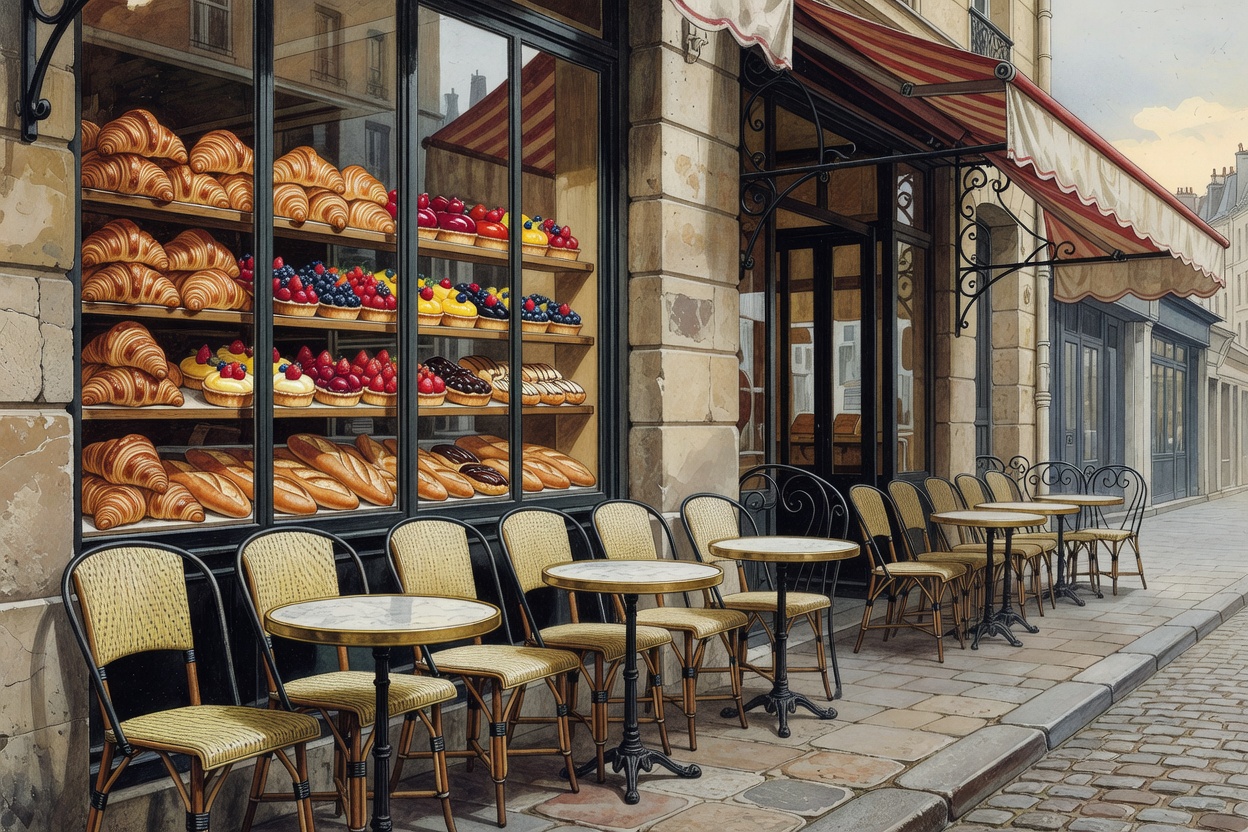
Illustration of a Parisian café terrace with cane chairs beside a bakery window stacked with croissants and tarts

The five guides

Everything worth queueing for, sorted into five parts

Paris does not hand over its pastry in one piece. It arrives in layers — morning dough, afternoon cream, evening coffee — so the guides are cut the same way.

01

Croissants, baguettes and the laminated morning

What lamination actually is, why a croissant made with AOP Charentes-Poitou butter behaves differently in the mouth, and how the straight-versus-curved shaping convention works. Takes in the sourdough wheels at Poilâne on rue du Cherche-Midi, the pain des amis and pistachio escargots at Du Pain et des Idées, and the annual Grand Prix de la Baguette de Tradition Française run by the City of Paris.

Read the viennoiserie guide →

02

The classic pâtisserie repertoire

The canon, and where each piece came from: the Paris-Brest and its cycling-wheel silhouette, the baba au rhum and Stohrer on rue Montorgueil, the Saint-Honoré and its Chiboust cream, the opéra credited to Dalloyau, Pierre Hermé's Ispahan, and the trompe-l'œil fruit Cédric Grolet makes at Le Meurice.

Read the pâtisserie guide →

03

Café culture, from zinc counter to filter cone

Why the same espresso costs less standing up, what separates a café from a bistrot and a brasserie, and how Le Procope, Café de Flore, Les Deux Magots, Le Select and La Rotonde earned their reputations. Then the specialty roasting wave — Belleville Brûlerie, Coutume, Ten Belles — and what it changed about ordering coffee.

Read the café guide →

04

Neighbourhood by neighbourhood

A walking-shaped map: rue Montorgueil in the 2nd, rue des Martyrs climbing towards the 9th, the Canal Saint-Martin and rue Yves Toudic in the 10th, Saint-Germain-des-Prés in the 6th, Oberkampf and Belleville out east, and the Rivoli side of the 1st where Angelina pours its thick hot chocolate.

Read the neighbourhood guide →

05

Ordering, timing and the words that matter

The vocabulary that gets you the right cup: noisette, allongé, café crème, déca. Why sur place and à emporter are billed under different reduced VAT rates, what the 1998 law on the word boulangerie guarantees, what the 1993 decree on pain de tradition française permits, and why service is already included.

Read the ordering guide →
How we choose

What makes a counter worth a detour

Reputation travels faster than quality in this city. These are the criteria we apply before a place earns a paragraph — plain tests you can run yourself, standing on the pavement with a paper bag in your hand.

The dough does the talking

A good croissant is honeycomb inside and lacquer outside. It sheds when you tear it and leaves a greasy ghost on the paper. If the crumb is bready and even, the lamination was rushed, whatever the window display promises.

A short, repeated range

Counters that make eight things properly beat counters that make forty things adequately. Repetition is how a bakery gets good: the same dough, the same oven, the same hands, every morning before the light comes up.

Turnover you can see

Trays that empty and refill are the single most reliable signal in Paris. A queue of people carrying bread home at six in the evening tells you more than any plaque on the wall.

Honest sourcing, plainly stated

Butter named on the label, flour named on the sack, fruit that matches the season on the tart. Houses that are proud of their suppliers tend to say so on a chalkboard rather than hide it behind an adjective.

A counter that works standing up

The comptoir is the beating heart of a Parisian café. Where the barman keeps the standing trade moving and the coffee arrives before your coat is off, the room is usually run by someone who cares.

Prices posted, no theatre

Displayed tariffs are a legal requirement in French cafés, and reading them is the fastest way to understand a room. Three columns — counter, room, terrace — is normal practice, not a trick.

Use the guides as a route, not a list

Paris rewards the short walk. Pick one guide, pick one street inside it, and give yourself a morning: a laminated pastry at the start, a coffee standing at a counter in the middle, something with cream on it at the end. The neighbourhood guide is built to be walked in exactly that shape, and the ordering guide makes sure the words arrive before the pastry does.